As an Amazon Associate this site earns from qualifying purchases.
Quick Picks
| Boot | Toe protection | Break-in-relevant construction | Link |
|---|---|---|---|
| Wolverine Men'sOverpass 6" Mid Composite Toe Waterproof Work Boot | Composite toe, ASTM F2413-11 M I/75 C/75 EH | Flexible, athletic contour welt construction that bends and flexes at essential points; removable OrthoLite cushioned footbed | Check Price on Amazon |
| NORTIV 8 Waterproof Steel Toe Work Boots for Men | Steel toe and rubber toe cap, ASTM 2413-18 | Mesh-covered EVA insole and lightweight EVA midsole | Check Price on Amazon |
| Hogent Steel Toe Boots for Men, Cushioned Safety Work Shoes | Steel toe cap, plus a lightweight KEVLAR puncture-resistant layer | Lightweight EVA soles and responsive air cushioning; high-top design | Check Price on Amazon |
Disclosure: We earn a small commission from qualifying Amazon purchases at no extra cost to you.
As an Amazon Associate we earn from qualifying purchases. This page contains affiliate links, and we may receive a commission if you buy through them — at no extra cost to you.
As an Amazon Associate, we earn from qualifying purchases.
Last Updated: September 2026
The short answer: break in new work boots gradually — two to four hours a day at home over roughly a week, wearing the exact socks you'll wear on shift, with the laces snugged tight over the instep so your heel cannot lift. Cover hot spots with tape or a blister patch before they hurt, not after. And here's the thing most people get backwards: a boot that is genuinely the wrong size does not break in. It just breaks you.
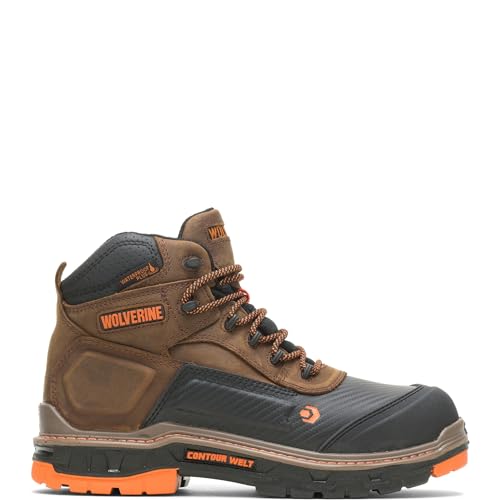
- Flexible, athletic contour welt construction moves with you by bending and flexing at essential points
- Premium waterproof leather with abrasion resistant toe
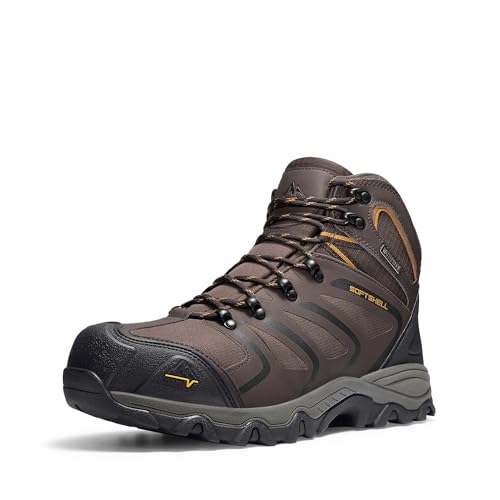
- Enhanced Toe Protection: These work boots for men feature a steel toe and rubber toe cap meets ASTM 2413-18 standard, that protect your feet from falling objects and accidental
- Waterproof Upper: With a static waterproof upper that lasts for up to 4 hours, these men's steel toe boots keep feet dry and comfortable even in wet and challenging work
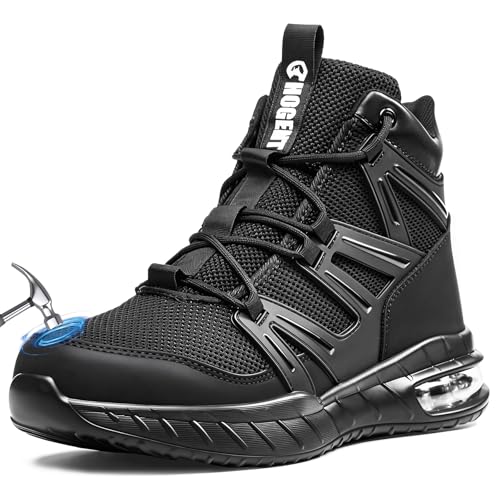
- 【STEEL TOE PROTECTION】: Hogent steel toe boots for men feature a protective steel toe cap for demanding jobs; high-top coverage adds ankle support; these steel toe shoes combine
- 【PUNCTURE-RESISTANT SUPPORT】: Built with a lightweight KEVLAR layer to help protect feet from nails and sharp objects; these work boots for men offer flexible support and
The Problem: Why New Work Boots Cause Blisters
Blisters are friction damage. When your heel slides even a few millimetres inside a stiff new boot on every step, the skin's outer layers shear against the layers beneath and fluid fills the gap. Heat and moisture make it worse, because damp skin grips the sock and the sock grips the leather.
That's why the classic work boot blister sits on the back of the heel and along the inside edge of the big toe. Those are the two places a new upper is stiffest and your foot moves most.
So breaking in a boot really means three separate things happening at once:
- The upper softening and creasing where your foot flexes.
- The footbed and midsole compressing into the shape of your arch and heel.
- Your skin toughening slightly at the contact points.
Step-by-Step: How to Break In Work Boots
Step 1: Confirm the size before you commit
Do this on day one, indoors, with the receipt intact. Lace the boot fully, stand up, and check that you can wiggle your toes but cannot slide your heel up and down more than a slight lift. Then walk a hallway. Pain across the ball of the foot or numbness in the toes is a width problem, and width problems do not resolve with wear.
Safety toes make this harder to judge. A composite or steel toe cap is a rigid box that will never mould to your foot, so if your longest toe touches the cap while standing, size up or change models. Both the NORTIV 8 Waterproof Steel Toe Work Boots for Men and the Hogent Steel Toe Boots for Men use a steel toe cap, and the Wolverine Overpass uses a composite toe rated to ASTM F2413-11 M I/75 C/75 EH — all three are rigid at the front by design.
Step 2: Wear them indoors, two hours at a time
Days one through three: two hours a day on carpet or a smooth floor, in your work socks. No walking outside — you want to be able to return them if the fit is wrong.
This is the step people skip, and it's the cheapest insurance you have.
Step 3: Add distance, not hours on a job site
Days four through seven: extend to three or four hours and add real walking. Stairs matter here, because stair climbing is where the boot has to flex at the ball of the foot. A boot built to bend at defined points, like the Wolverine Overpass with its flexible athletic contour welt construction that moves by bending and flexing at essential points, is doing the work you'd otherwise have to force out of stiff leather.
Step 4: Fix the heel with your lacing
Most heel rub is a lacing failure, not a leather failure. Use a heel-lock (surgeon's knot): tighten the laces normally to the ankle, tie a double-wrapped knot at the top of the instep to lock that tension in, then finish the top eyelets. Your heel gets pinned into the back of the boot and stops sliding.
Step 5: Manage moisture and hot spots
Wear one pair of thicker socks or a thin liner under a work sock. Change socks at lunch if your feet sweat. The moment you feel warmth at the heel or toe, stop and tape it — a hot spot taped early almost never becomes a blister.
Step 6: Rotate and rest the boots
Give boots at least a partial day to dry between long wears. On waterproof boots this matters more, because a sealed upper has fewer paths for sweat to escape.
Tools and Boots That Shorten the Break-In
Before anything else: the cheap fixes. Moisture-wicking socks, a roll of kinesiology or paper tape, blister patches, and a proper heel-lock lacing technique will prevent more blisters than any product swap. Leather conditioner helps soften a full-grain upper, but use it sparingly and never force-dry a wet boot near a heater.
When the boot itself is the problem, look for three things on the spec sheet: a flexible sole construction, a removable footbed, and cushioning that doesn't rely on the leather softening.
Wolverine Men'sOverpass 6" Mid Composite Toe Waterproof Work Boot — Best for a leather boot you want to flex early
This is the pick for anyone who wants a leather work boot but not a two-month break-in ordeal. The listing specifies flexible, athletic contour welt construction that moves with you by bending and flexing at essential points, plus a removable OrthoLite cushioned footbed [S3]. That removable footbed is the underrated feature here — it means you can pull the factory insole and drop in your own orthotic or a thicker aftermarket insole if the stock volume doesn't suit your arch, which is the single most effective fix for arch-strain and heel-lift complaints.
The listing describes the upper as premium waterproof leather with an abrasion-resistant toe, and the outsole as slip, oil, water, abrasion and chemical resistant [S3]. Protection is listed as a composite toe rated ASTM F2413-11 M I/75 C/75 EH [S3] — composite rather than steel, which some wearers prefer for weight and for cold weather, though the supplied listing does not state a weight figure.
Strengths: flexible welt construction aimed at movement; removable cushioned footbed; waterproof leather upper; EH-rated composite toe.
Limitations to know: the supplied listing information does not state a shaft height beyond the 6" description in the product name, an insulation rating, or a warranty length. The specific pair described in the record is Summer Brown, 9.5 Medium.
NORTIV 8 Waterproof Steel Toe Work Boots for Men — Best for long standing shifts where EVA cushioning carries the comfort
If your break-in misery is mostly foot fatigue rather than heel friction, the construction here is worth a look. The listing describes a mesh-covered EVA insole for support and a lightweight EVA midsole intended to relieve foot fatigue from prolonged standing or walking [S4]. EVA compresses and rebounds without needing to be broken in the way stiff leather does, so the comfort you get in week one should be close to the comfort you get in week six — that is an inference from the material, not a measured result.
Toe protection is a steel toe with a rubber toe cap meeting ASTM 2413-18, and the lugged rubber outsole meets ASTM F3445-13 for traction [S4]. The manufacturer positions these for construction sites, warehouses, mines, welding, carpentry and landscaping [S4].
Read this carefully: the waterproofing claim is specific and bounded. NORTIV 8 describes a static waterproof upper that lasts for up to 4 hours [S4]. "Static" and "up to 4 hours" is a seller-stated limit, not an all-day membrane, so do not treat this boot as a standing-water or full-shift-in-the-rain solution on the strength of that wording.
Strengths: dual-standard citation for toe and outsole; EVA insole and midsole aimed at long standing shifts.
Limitations to know: the 4-hour static waterproof rating is the manufacturer's own stated limit; the supplied listing does not state an EH rating, weight, or insulation.
Hogent Steel Toe Boots for Men, Cushioned Safety Work Shoes — Best for puncture risk plus ankle support
This one earns its slot on a specific pairing: a steel toe cap alongside a lightweight KEVLAR layer intended to help protect feet from nails and sharp objects, in a high-top design that the manufacturer says adds ankle support [S5]. If you work around demolition debris, framing offcuts or scrap, underfoot puncture protection is the hazard people underestimate.
For break-in specifically, the relevant claims are responsive air cushioning to absorb impact, a breathable lining to promote airflow, and lightweight EVA soles providing flexible cushioning [S5]. Breathability is a genuine blister variable — drier skin shears less — though the listing gives no measured airflow figure, so treat that as a design intent rather than a proven number.
Strengths: steel toe plus KEVLAR puncture-resistant layer; high-top coverage; EVA sole and air cushioning; the manufacturer states it is available for men and women.
Limitations to know: the supplied listing does not cite a specific ASTM standard number for the toe cap or the puncture layer, does not state waterproofing, and does not state a weight. If your employer requires a documented ASTM rating on the label, confirm that with the seller before buying.
Tips for Best Results
- Buy boots late in the day. Feet swell over a shift; a boot fitted to a morning foot gets tight by 3pm.
- Use the same socks every time. Sock thickness changes fit more than most people expect.
- Lace from the bottom up, in stages. Tension the forefoot, then the instep, then the ankle separately.
- Tape before the walk, not after the pain.
- Pull the insole out to check length. Stand on it — your heel and toes should sit inside the outline.
- Let waterproof boots dry fully. Air, not heat.
Common Mistakes to Avoid
- Soaking boots or wearing them wet to "mould" them. This can degrade leather and adhesives, and it does nothing for a rigid safety toe.
- Heat guns, ovens and radiators. Fast way to crack an upper.
- Wearing brand-new boots for a full first shift. This is how a hot spot becomes a two-week limp.
- Assuming a safety toe will stretch. It will not. Both steel-toe boots here and the composite-toe Wolverine have a rigid cap by design [S3][S4][S5].
- Ignoring width. Length is easy to judge; width is what actually causes the ball-of-foot and little-toe blisters.
How We Research
This website does not run a lab and does not do product research. For this guide, the three boots were selected and described from Amazon Creators API verified product records retrieved on 8 September 2026, and from the published product listing feature bullets on each listing [S3][S4][S5]. Where a listing names a standard — ASTM F2413-11 M I/75 C/75 EH on the Wolverine, ASTM 2413-18 and ASTM F3445-13 on the NORTIV 8 — that is the seller's own published wording, reproduced here with its scope intact rather than generalised into independent verification. Where a listing is silent, this guide says so instead of guessing.
For general consumer safety and recall information, readers can check CPSC and USA.gov consumer protection [S1][S2].
Final Verdict
Honestly, the break-in process is 70% technique and 30% boot. Get the size right, lock your heel with a surgeon's knot, wear them indoors first, and tape hot spots early — do that and almost any decent boot becomes wearable inside a week.
If you want the boot itself to do more of the work, the Wolverine Men'sOverpass 6" Mid Composite Toe Waterproof Work Boot is the most directly relevant pick for break-in, because it is the only one of these three whose listing describes both a flexible welt built to bend at specific flex points and a removable cushioned footbed you can swap for your own orthotic [S3]. That combination targets the two things that actually hurt in week one.
If your shifts are long and standing-heavy, the NORTIV 8 Waterproof Steel Toe Work Boots for Men leans on EVA insole and midsole cushioning rather than leather softening [S4] — just treat its waterproofing as the bounded, seller-stated 4-hour static claim it is. And if nails and scrap underfoot are your real risk, the Hogent Steel Toe Boots for Men add a KEVLAR puncture-resistant layer that neither of the other two listings mentions [S5].
Frequently Asked Questions
There is no universal figure, and none of the supplied listings state one. A practical schedule is one to two weeks of gradually increasing wear, starting at about two hours indoors. Stiffer, thicker full-grain uppers generally take longer than boots relying on EVA cushioning.
Why do my work boots rub my heel?
Usually heel lift — the boot's heel counter is too roomy or your laces aren't locking the instep. Try a heel-lock lacing knot first, then a thicker sock or a heel grip pad. If the rubbing persists after both, the boot is too large.
Will a steel toe boot stretch to fit my toes?
No. A steel or composite toe cap is a rigid protective box and will not conform to your foot, which is why length and width need to be right at purchase.
Can I speed up break-in by wetting my boots?
Skip it. Soaking risks the leather, the lining and the adhesives, and it cannot change a rigid safety toe. Gradual dry wear plus a light leather conditioner is the safer route.
Do waterproof work boots break in differently?
They can feel warmer, since a sealed upper limits how quickly sweat escapes, and damp skin blisters more easily. Change socks mid-shift and let the boots dry fully between wears.
Are removable insoles worth looking for?
Yes, if you have arch issues or need volume adjustment. The Wolverine Overpass listing specifically describes a removable OrthoLite cushioned footbed [S3], which lets you swap in an orthotic without buying a different boot.
Should I break in boots at work or at home?
At home, always, for the first few sessions. You can stop the moment something hurts, and you keep the option to return an unworn-outdoors boot.
Related Resources
- Choosing between steel toe and composite toe boots
- Best work socks for preventing blisters
- How to waterproof and condition leather boots
Sources & Methodology
Nobody on this website wore, flexed, soaked or measured any of these boots — there was no physical or laboratory testing of any kind behind this guide. What sits behind it is a close reading of three Amazon Creators API verified product records and their published listing feature bullets, all retrieved on 8 September 2026, with particular attention to which safety standards each seller actually names in its own text and how tightly each claim is worded (NORTIV 8's "up to 4 hours" static waterproof phrasing being the clearest example of a limit worth preserving). For work boots, that level of evidence tells you which standards a seller cites, what its sole and footbed are made of, and therefore how much break-in stiffness you should expect — but it is not independent certification testing, and it cannot tell you how a given last will fit your foot, which remains something only you can confirm at home.